Forex trading in the Philippines usually means speculating on currency prices through a leveraged online product, not exchanging pesos for travel money at a bank.
The app may look simple, but a trade still involves a contracting company, margin rules, price execution and a payment route back to the account holder.
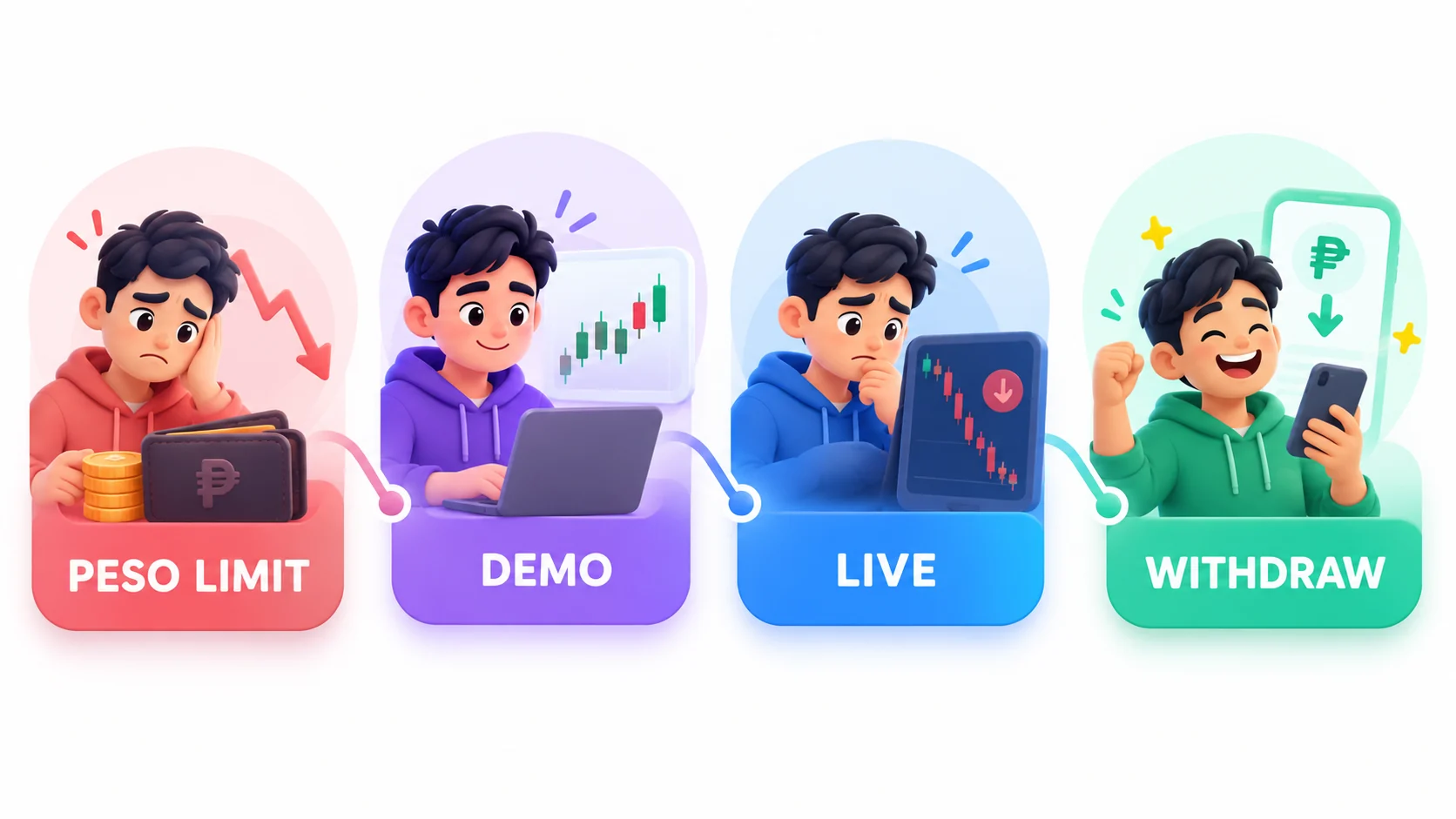
A safer starting plan sets a peso loss limit before a deposit target, tests one setup on demo and checks the provider’s legal identity before any live transfer.
What Forex Trading Means for a Philippine Resident
Online forex trading in the Philippines can describe different products, and the legal rights and financial risks depend on which product is actually used.
Exchanging Currency Is Not the Same as Trading a Forex CFD
| Activity | What the customer receives | Leverage | Main purpose |
|---|---|---|---|
| Bank or money-changer exchange | Foreign currency or a foreign-currency balance | Normally none | Travel, payment or holding currency |
| Retail forex CFD | A contract linked to a currency pair’s price | Often available | Speculation on price movement |
| Exchange-traded currency product | A listed contract under exchange rules | Product-specific | Trading or hedging |
Forex trading for a Philippine resident commonly involves a CFD, which creates profit or loss from a price difference without delivering the two physical currencies.
A USD/PHP exchange at a bank changes the currency held, while a leveraged EUR/USD position creates exposure under the broker’s contract.
The Contracting Company Matters More Than the App Name
A forex trading app can be shared by several companies in a global broker group, so the brand displayed on the phone does not identify the legal counterparty.
The client agreement should name the company accepting the account, the governing law, the dispute route and any regulator covering that entity.
Those details decide where a Philippine customer can complain and which protections apply if the account or withdrawal is disputed.
The Money Path Behind an Online Forex Trade
The money path in forex trading in the Philippines begins before the order ticket and ends only when a withdrawal reaches an account held in the customer’s name.
From Philippine Pesos to a Trading Account
A PHP deposit for online forex trading may pass through a bank, card network, wallet or payment processor before the broker credits the trading account.
The displayed deposit amount can differ from the usable account value because of PHP conversion, processor charges or a different base currency.
A visible GCash or Maya button proves only that the option appears in that account at that moment; it does not establish the contracting entity or Philippine authorisation.
From an Order Ticket to Profit or Loss
An online forex order contains the symbol, direction, volume and optional stop or limit instructions, then travels to the broker server for acceptance and execution.
The filled price can differ from the requested price when the market moves or available liquidity changes, which is called slippage.
Profit or loss then changes with the position size, price movement, spread, commission, financing and any account-currency conversion.
From a Withdrawal Request Back to the Account Holder
A forex withdrawal normally requires the account name, identity record and destination ownership to match the customer who funded the account.
Some providers return deposited funds to the original payment source before sending profits by another available route.
Record the broker’s reference, the processor reference and the receiving bank record separately, because each organisation controls a different part of the transfer.
What Philippine Rules Change for Forex Traders
Philippine forex rules do not reduce to a single licence label, because personal trading, public solicitation, payments and taxation involve different conduct.
Personal Trading, Promotion and Client-Money Activity
A person trading only personal funds is doing something different from selling investments, recruiting clients, controlling another user’s account or collecting pooled money.
The legal analysis for forex trading in the Philippines changes when payment, referral income, discretion over another person’s funds or promised returns enter the arrangement.
The guide to forex trading legality in the Philippines maps those activities separately instead of treating every forex-related act as identical.
The Different Roles of the SEC, BSP and BIR
The SEC handles securities registration, public offers, intermediaries and enforcement within its authority.
The BSP maintains the Philippine framework for foreign-exchange transactions and regulated financial institutions.
The BSP foreign-exchange regulations page covers banks, entities, overseas Filipinos and the public, but it is not a list approving every offshore CFD broker.
The BIR deals with tax administration, making transaction records and peso conversions relevant even when the platform account uses another currency.
Starting With a Loss Limit Instead of a Deposit Target
A deposit answers how much money enters a forex account, but a loss limit answers how much a Philippine household can lose without affecting essential expenses.
How Leverage Changes a Small Price Move
Leverage lets a forex trader control exposure larger than the cash posted as margin, so a small price move can create a much larger percentage change in account equity.
For example, ₱5,000 of margin supporting ₱500,000 of exposure represents 100:1 leverage; a 1% adverse move is about ₱5,000 before spread, commission and conversion.
The broker’s margin and stop-out rules may close a position before or after that simplified example, depending on other positions and available equity.
A Sample Risk Budget in Philippine Pesos
| Planning item | Illustrative amount | Purpose |
|---|---|---|
| Separate trading capital | ₱20,000 | Defines the money exposed to the activity |
| Maximum planned loss per trade | ₱200 | 1% of the example capital |
| Maximum planned daily loss | ₱600 | Stops a series after three full-risk losses |
| Monthly review point | ₱2,000 drawdown | Pauses live trading for a process review |
This forex trading example is not a recommended deposit or return target; the amounts show how an account limit can be translated into a position-level rule.
A household with no genuinely separate trading capital should remain on demo rather than turning an essential payment into market risk.
Why Stop-Loss Orders Cannot Guarantee the Exit Price
A stop-loss order usually becomes executable after the trigger price is reached, but the final forex fill can be worse when price moves quickly or reopens after a gap.
Position size should therefore leave room for slippage instead of assuming the planned stop creates a fixed maximum loss.
A guaranteed stop is a separate broker feature with its own availability and cost; an ordinary stop should not be described as guaranteed.
Four Gates Before Moving From Demo to Live Trading
Demo-to-live forex trading should wait until the product, provider, payment route and personal risk limit have each passed a separate gate.
Product Knowledge Gate
The product gate requires a Philippine beginner to explain the forex pair, pip value, position size, margin, liquidation level and total cost before using live money.
A demo order should include entry, invalidation, stop, target and the peso value of the planned loss.
If the amount at risk cannot be calculated before the order, the trade has not passed this gate.
Provider and Contract Gate
The provider gate for forex trading in the Philippines requires the legal company, client agreement, regulator and any Philippine SEC material to point to a coherent account relationship.
A licence held by one group company does not automatically protect an account contracted with another company.
The Philippine forex broker shortlist applies this gate before comparing spreads or platforms.
Payment and Withdrawal Gate
The payment gate identifies the deposit owner, destination owner, currencies, fees, refund priority and expected references for the forex account.
A payment method should remain unverified for Philippine users when it appears only in an advertisement or an old review rather than the individual account.
A small round trip can test the workflow, but one successful withdrawal cannot prove every future request will follow the same timing.
Personal Risk Gate
The personal gate asks whether forex trading can be paused without affecting rent, food, debt payments, tuition, medical costs or emergency savings.
The SEC’s Investment 101 guidance states that currency trading has no guaranteed return and should not be entered without understanding the mechanics and danger.
If a loss would create pressure to recover money quickly, live leverage is not an appropriate next step.
Planning the First 30 Forex Trades
The first 30 forex trades should test a repeatable process, not attempt to establish a monthly income from a very small sample.
Build One Repeatable Setup on Demo
A useful forex demo plan keeps the session, currency pair, setup and risk calculation stable long enough to reveal mistakes.
Changing indicators and markets after every loss makes it difficult to tell whether the method or the execution caused the result.
Demo trading cannot reproduce the emotional pressure of live loss, but it can expose order-entry, platform and record-keeping errors.
Record Spread, Slippage and Decision Quality
A forex journal should preserve the planned price, filled price, spread, stop distance, screenshot and reason for entry rather than recording profit alone.
Decision quality asks whether the written rule was followed, while trade outcome records what happened after the market moved.
A valid process can lose, and a poor decision can win, so both columns are needed before changing the method.
Increase Size Only After Reviewing the Journal
Position size in forex trading should not increase because of one winning streak or a desire to recover a drawdown.
Review whether losses stayed within the written limit, platform errors were resolved and the setup was followed across different days.
If the process fails those tests, more volume magnifies the same problem instead of fixing it.
Choosing a Forex Setup for Daily Life in the Philippines
A Philippine forex setup should fit the trader’s available screen, connection and time rather than copy a workstation shown on social media.
Mobile-First Trading
Mobile forex trading is useful for alerts, position checks and predefined orders, but a small screen can hide price scale, account mode or the selected symbol.
Biometrics can speed up access, while two-factor authentication and a protected email account remain separate controls.
The forex app guide for the Philippines compares mobile tools by role instead of assuming one app should handle every task.
Desktop Charting and Automation
A desktop forex platform offers more chart space, detailed order controls, file exports and, on supported software, strategy testing or automation.
An automated strategy still depends on the broker server, symbol specification, connection and code, so it does not remove execution risk.
A low-spec laptop may perform better with fewer charts and indicators than with a complex layout copied from a high-performance machine.
Session Choice for Day Jobs and Night Shifts
Forex trading around a Philippine day job may favour the later London hours, while a BPO night shift can make the Tokyo morning easier to follow.
The PHT forex session planner shows how London and New York move when their clocks change.
The better session is the one that allows preparation, monitoring and review without using sleep deprivation as part of the strategy.
Records, Taxes and Scam Signals
Forex records protect both tax reporting and dispute recovery, while common scam signals often appear before any verifiable trade is made.
Keep a Peso-Based Transaction Record
A forex transaction record should include the date, amount, original currency, PHP equivalent, fee, account number and payment reference.
Trading statements preserve positions and costs, while bank and wallet records show the cash that actually entered or left the Philippine account.
A Philippine CPA can determine the correct tax treatment from the person’s facts; an online article cannot assign one rate to every trader.
Walk Away From Guaranteed Returns and Account Access Requests
Guaranteed forex returns, urgent deposits, personal bank destinations, remote-access software and requests for a password or one-time code are reasons to stop the transaction.
The Philippine SEC states that there is no guaranteed return in currency trading and warns against high-pressure profit schemes.
A legitimate support agent can work from an account reference and identity process without asking to control the customer’s screen or receive an OTP.
Forex Trading FAQs in the Philippines
- How much money is needed to start forex trading in the Philippines?
-
A demo account requires no trading deposit. For live trading, the useful amount is the capital that remains separate from essential expenses and supports the planned peso loss per trade.
- Can forex trading become a reliable monthly income?
-
No fixed monthly income can be promised from forex trading. Returns vary, losses can exceed a planned amount through gaps or slippage, and a short winning sample does not establish reliability.
- Is a demo account the same as live trading?
-
No. Demo trading can test platform use and written rules, but live execution, payment processing and the emotional effect of losing money can differ.
Forex Trading in the Philippines Summary
Remain on demo until position size, margin, spread and the exit rule can be explained without relying on a salesperson or signal group.
Live funding makes sense only after the named counterparty, applicable agreement, complaint route and return path for the money all refer to the same customer relationship.
Do not proceed when the capital is needed for ordinary bills, when returns are promised, or when another person wants control of the device, password or one-time code.
Leave a Reply